With the advent of modern radio and radar systems came the need to provide stable harmonic oscillations at particular carrier frequencies to establish the required modulation and mixing conditions. While the carrier frequencies in the early days mostly reached into the low to mid MHz range, today’s RF systems easily surpass the 1 GHz mark. This has resulted in specialized circuits capable of providing stable and pure sinusoidal responses at low cost. What makes the design of an oscillator such a difficult task lies in the fact that we exploit an inherently nonlinear circuit behavior which can only be incompletely described with linear system tools. Specifically, the small-signal linear circuit models utilized to represent the active device provide limited capabilities to model the complicated feedback mechanism. Moreover, since an oscillator has to provide power to subsequent circuits, frequency dependent output loading often plays an important role. It is for these reasons that the design process of oscillators still remains more of an art than an exact engineering design task. This holds particularly true for the high-frequency regime where parasitic component influences can significantly impact the overall system performance. Affected in part by the additional resonance effects of the passive circuit element it is possible that the oscillator not only operates at the intended frequency, but also at lower or higher frequencies.
In the first part of this chapter our effort is concentrated on the negative resistance and feedback harmonic oscillators as well as a number of Schottky diode mixers. Once the fundamental idea is mastered of how to generate oscillations, we are going to investigate the basic Colpitts and Hartley resonators before moving to the modern RF-circuit design approaches involving the S-parameters of the active device in conjunction with the various network configurations.
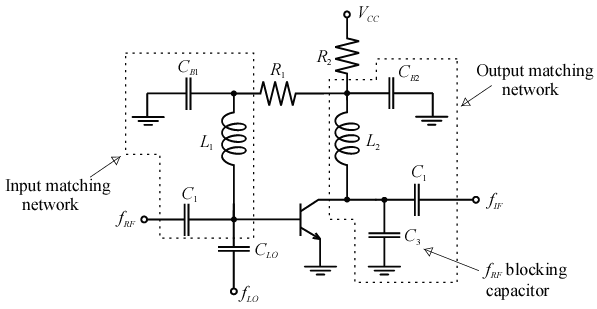
In the second part of this chapter, we turn our attention to the basic frequency translation tasks performed by mixers. Of the many different circuit implementations for a wide range of applications, the main emphasis is placed on down-converting diode, bipolar, and FET circuits.