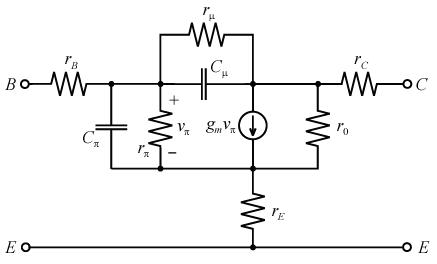
Almost all circuit designs of any complexity have to be modeled as part of computer aided design (CAD) programs prior to their practical realizations in order to quantitatively assess whether or not these circuits meet design specifications. For the purpose of electric circuit simulation, a large number of software analysis packages offer a host of different equivalent circuit models attempting to replicate the electric performance of the various discrete elements. Special electric circuit models have been developed to address such important design requirements as low or high frequency operation, linear or nonlinear system behavior, normal or inverse mode of operation to name but a few.
It is the purpose of this chapter to examine several active RF devices in terms of suitable diode as well as mono and bipolar transistor RF circuit representations. The physical foundation of these devices is reviewed in Chapter 6. By developing a close link with the previous chapter, we will be able to observe how a basic understanding of the solid-state device physics naturally leads to large signal (nonlinear) circuit models. Subsequent discussions will then focus on modifications that can be made to linearize these models and to refine them for high-frequency operations.
By introducing the various BJT models, we restrict our discussion to only the most popular types, i.e., the Ebers-Moll and Gummel-Poon models. Both types, and a number of linear derivatives, find widespread applications in such simulation tools as SPICE, ADS, MMICAD and others. Often the situation arises where the device manufacturer may not be able to supply all the required electric parameters, since they can easily exceed 40 independent parameters, and a so-called SPICE model representation is unattainable. Under those circumstances, the S-parameters are recorded for various bias conditions and operating frequencies to characterize the high frequency component behavior. In most cases, these S-parameters may provide the design engineer with sufficient information to complete the simulation task.