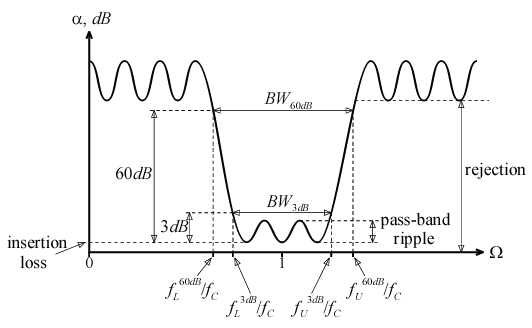
After our network discussion in Chapter 4, we are now in a position to extend and apply our knowledge of one- and two-port networks to develop RF filter configurations. It is of particular interest in any analog circuit design to manipulate high-frequency signals in such a way as to enhance or attenuate certain frequencies ranges or bands. This chapter examines the filtering of analog signals. As we know from elementary circuit courses, there are generally four types of filters: lowpass, highpass, bandpass, and bandstop. The lowpass filter allows low frequency components to be transmitted from the input to the output port with little attenuation. However, as the frequency exceeds a certain cut-off point, the attenuation applied to the input signal increases significantly with the result of delivering only a highly amplitude-reduced signal at the output port. The opposite behavior is true for a highpass filter where the low-frequency signal components are highly attenuated or reduced in amplitude, while beyond a cut-off frequency point the signal passes the filter with little attenuation. Bandpass and bandstop filters restrict the passband between certain lower and upper frequency points where the attenuation is either high (bandpass) or low (bandstop) compared to the remaining frequency band.
In this Chapter we intend to first review several fundamental concepts and definitions pertaining to filters and resonators. Specifically the key concept of loaded and unloaded quality factors will be examined in some detail. As a next step, we are going to introduce the basic, multi-section lowpass filter configuration for which tabulated coefficients have been developed both for the so-called maximally flat binomial, or Butterworth filter, and the equi-ripple or Chebyshev filter. The intent of Chapter 5 is not to introduce the reader to the entire filter theory, particularly how to derive these coefficients, but rather how to utilize the coefficients in order to design a specific filter type. We will see that the normalized lowpass filter serves as the basic building block from which all four filter types can be derived.
Once we know the procedures of converting a standard lowpass filter design in Butterworth or Chebyshev configuration into a particular filter type that meets our requirements, we then need to investigate ways of implementing the filter through distributed transmission lines. This step is critical, since at frequencies above 500 MHz concentrated elements such as inductors or capacitors are unsuitable. Relying on Richards’ transformation, which converts lumped into distributed elements, and Kuroda’s identities, we are given powerful tools to develop a wide range of practically realizable filter configurations.