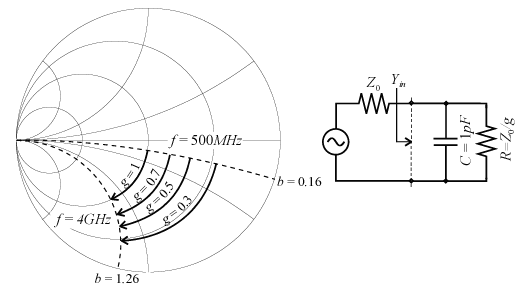
The input impedance of a transmission line depends on the dielectric properties as well as on its geometric dimensions. Typical practical realizations are microstrip line, coaxial cable, parallel-plate line, etc. In addition, both length and operating frequency of the transmission line significantly influence the impedance of the line. In the previous chapter we derived the fundamental equation describing the input impedance of a terminated transmission line. We found that this equation incorporates the characteristic line impedance, the load impedance and, through the argument in the tangent function, the line length and operating frequency. As we saw in Section 2.9, the input impedance can equivalently be evaluated by using the spatially dependent reflection coefficient. To facilitate the evaluation of the reflection coefficient, P. H. Smith developed a graphical procedure based on conformal mapping principles. This approach permits an easy and intuitive display of the reflection coefficient as well as the complex impedance in one single figure. Although this graphical procedure, nowadays known as the Smith Chart, was developed in the 1930s prior to the computer age, it has retained its popularity and today can be found in every data book describing passive and active RF/MW components and systems. Almost all computer-aided design (CAD) programs utilize the Smith Chart for the analysis of circuit impedances, design of matching networks, and computations of noise figures and stability circles.
This chapter reviews the steps necessary to convert the input impedance in its standard complex plane into a suitable complex reflection coefficient representation via a specific conformal transformation originally proposed by Smith. The graphical display of the reflection coefficient in this new complex plane can then be utilized to directly find the input impedance of the transmission line. Moreover, the Smith Chart facilitates the evaluation of more complicated circuit configurations which will be employed in subsequent chapters to build filters, mixers, and matching networks for active devices.
Goal of the following sections is a step-by-step derivation of the Smith Chart followed by several examples of how to use this graphical design tool in computing the impedance of passive circuits.